By: Leila Hall
Originally posted on OSISA website.
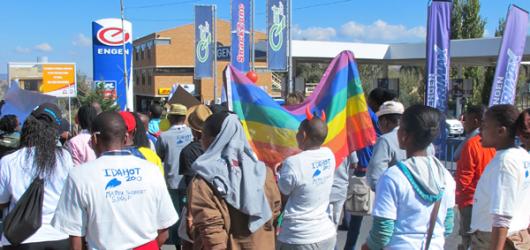
A small group of young Basotho are singing and chanting as they make their way down Kingsway – the main street that runs through the centre of Maseru, Lesotho’s capital city. At first glance, this is not an unusual sight. They sing familiar, well-known songs – the kind that you would hear at any soccer match – supe, supe pe pe, zabalabalaba. They break and move and stop and dance, then keep moving forward with an easy, effortless rhythm.
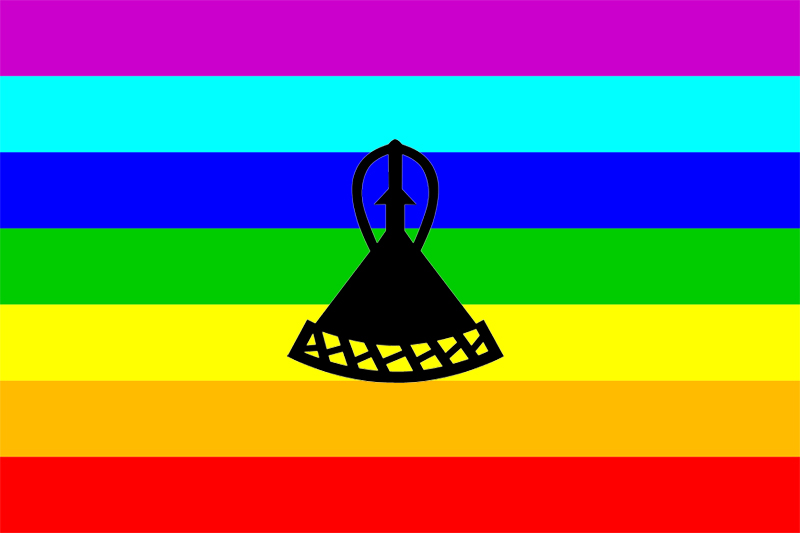
But as the procession draws nearer, it quickly becomes clear to passers-by that there is something different about this group. Something about the colour and the movement of the procession catches the onlookers’ eyes. Yellow balloons. Pink sunglasses. A pair of red devil horns. Bursts of brightly coloured clothing. In the midst of the singing, stomping and clapping, two people carry between them a large, rainbow flag.
The banner at the front of the procession proclaims loudly and clearly what this is all about – ‘International Anti-Homophobia and Transphobia Day’. It is Saturday the 18th of May 2013 and today, this small, colourful group is making history – this is Lesotho’s first-ever gay pride march.
The event has been organised by MATRIX Support Group – a Lesotho-based NGO working to advocate for the rights of lesbian, gay, bisexual, transgender and intersex (LGBTI) individuals in the country. The organisation, which only received legal recognition in 2010, is – like this year’s parade – the first of its kind in Lesotho.
The march ends at the local Ster Kinekor Cinema, where a film screening has been organised. Rainbow banners line the walls. Chatter and laughter fill the room. A man in a small summer dress, flower hat and white boots confidently walks into the cinema and finds a seat near the front.
32-year-old, Lineo ‘Sheriff’ Mothopeng – a self-identified transman and member of the MATRIX organising committee – walks onto the stage and asks for a volunteer lead the group in prayer. Everybody stands up. The men take their hats off. Arms are folded, and the cinema fills with slow, steady hymn singing: a customary way to begin any meeting or gathering in the country.
Then Sheriff speaks into the mic. “People say God hates gays, but at least I know they can pray.”
Sheriff is followed by Tampose ‘Tee Pee’ Mothopeng another member of the organising committee who says, “Yesterday, I was sitting somewhere with one of our lesbians. She was telling me that in the past few months, she was beaten up by some guy. Her face was so damaged that she said you couldn’t identify her at all. We want to take that devil out, out of this country! We are taking it OUT!”
Tee Pee’s voice rises to a yell. He is met with shouts and murmurs of approval from the audience. “Discrimination, we are taking it out! Violence, we are taking it out! But it’s not me who’s going to stand up for that. It’s us, people. We need to join hands to stand up for our rights.”
In Lesotho, female same-sex sexual activity is not criminalised, but male same-sex sodomy is illegal as a common law offence. The country’s law offers no protection to individuals against discrimination based on their sexual orientation or gender identity. However, as Sheriff explains, the sodomy law is a ‘silent’ law. “It has been around since 1976, but I’ve never heard of anybody being convicted,” he says. “At the same time, it is a silent weapon: people hide behind the sodomy law and use this as an excuse not to implement programmes.”
Lesotho has the world’s third-highest HIV prevalence rate and, as is the case in many countries, men who have sex with men (MSM) have been identified as a particularly vulnerable group. However, the criminalisation of male same-sex sexual relations, together with widespread homophobic attitudes, make it difficult for MSM to openly access the education, health care services and HIV prevention products that they need.
“MSM are not included in HIV programs in this country,” says Sheriff. “There are many cases where they are included in writing – such as in our National AIDS Strategy – but there is no implementation. We do not have gay-friendly health services. As a result of cultural beliefs and the taboo around homosexuality, people do not disclose their sexual practices, and so health-care workers are not able to respond to the challenges that MSM face.”
This year, MATRIX will be working with Population Services International (PSI) Lesotho on the country’s first HIV prevention programme to specifically target MSM. The project will include the distribution of high-quality condoms and condom-compatible lubricants. “The serious challenge is that we don’t know how many MSM there are in the country,” Sheriff explains. “Many people are still in the closet so it is hard to implement programmes, because we don’t know how many are out there.”
Being unable to be open about one’s sexual orientation and/or gender identity continues to be a challenge faced by many LGBTI people in Lesotho. In rural communities in particular, traditional gender roles are firmly entrenched and those who do not conform are often subjected to discrimination and abuse from community members. 24-year-old Rethabile Mosoka explains that it isn’t easy to be a lesbian in Lesotho. “People don’t want girls to act like boys and boys to act like girls,” she says. “People in the community look at us and say: ‘You girls, you don’t sweep, you go out and smoke and act like boys’. Men especially don’t like it.”
Meanwhile, Ariel ‘Angel’ Thoko, who identifies as a transwoman, recalls the challenges she faced growing up. “I’ve always known that I’m a girl, but at some point this was very difficult for my uncle to accept,” she says. “He would force me to go look after cattle, to go ploughing, and to talk in a deep voice: all these things that men do.”
Lesotho is a predominantly Christian country, and religious viewpoints underpin the intolerant and homophobic attitudes that many people still hold.
“The biggest challenge comes from religious perspectives,” says Sheriff. “People talk about what the Bible says, and most of the complaints we get from religious leaders are founded on not understanding. It is a challenge that we are yet to respond to. We are planning a project with Inclusive and Affirming Ministries (IAM) in which we hope to create dialogue between religious leaders and LGBTI community members.”
However, despite all these challenges, Sheriff is confident that attitudes in the country are slowly changing for the better.
“I was worried that we wouldn’t get a permit from the police to hold the march, but it took less than ten minutes,” Sheriff says. “Everybody was curious but supportive. Most of the time people’s views are based on a lack of knowledge. But MATRIX has already done a lot. When we used to screen films in communities people would say ‘What are you talking about? This is satanic’. But now, I feel that people’s response is more positive. People are willing to learn more, to read more, and to engage in dialogue.”
And – who knows – maybe even join Lesotho’s gay pride marches in the years to come.



 The Hub